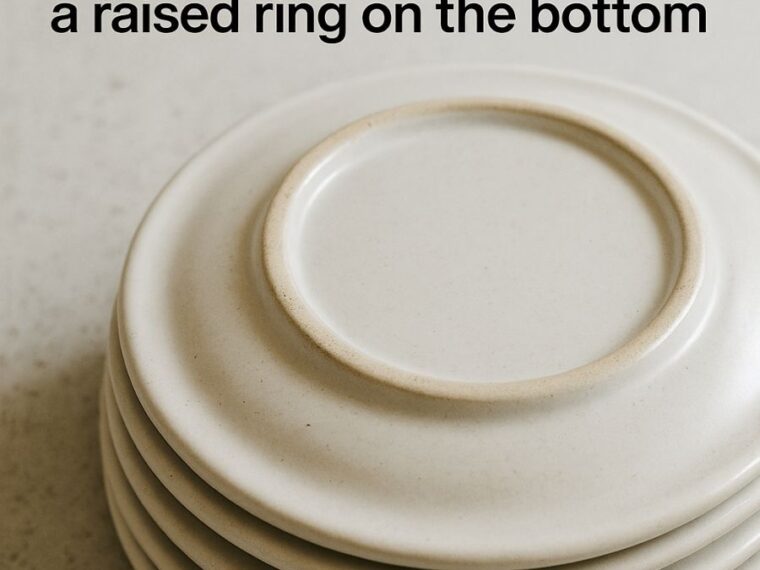
Most People Go Their Entire Lives Without Knowing Why Plates Have a Raised Ring on the Bottom
Flip over almost any ceramic plate, bowl, or dish in your kitchen and you’ll notice something curious: a raised ring around the base. It’s so common that we barely think about it. Yet this small design detail has big reasons behind it—reasons that combine science, craftsmanship, safety, and tradition.
Let’s uncover the quiet genius hiding under your plate 👇
🔍 First Things First: What Is That Ring Called?
That raised circle is called the foot ring (or foot rim). It’s not decoration, and it’s not accidental. Potters have been using it for thousands of years—long before modern kitchens existed.
1️⃣ Stability: Why Your Plate Doesn’t Slide Everywhere
The most important reason for the raised ring is balance.
🧠 Here’s how it helps:
- It creates three or more contact points with the table
- This prevents wobbling on slightly uneven surfaces
- It keeps the plate steady while cutting food
Without the ring, a flat-bottomed plate would:
- Rock back and forth
- Slide more easily
- Tip with pressure
✔ The ring acts like a tiny anchor.
2️⃣ Heat Protection: Saving Your Table (and Your Hands)
Ever put a hot plate down and worried about the table underneath?
🔥 The raised ring:
- Lifts the plate slightly off the surface
- Reduces direct heat transfer
- Protects wooden tables from burn marks
- Allows air to circulate underneath
This is especially important for:
- Oven-safe plates
- Microwave-heated dishes
- Stoneware and ceramic plates
✔ Less heat damage, more peace of mind.
3️⃣ Grip & Handling: Easier to Pick Up
That ring isn’t just for tables—it’s for you.
✋ When you pick up a plate:
- Your fingers naturally rest on the raised edge
- It provides a secure grip, even when hot
- Makes carrying food safer and more comfortable
Professional servers and chefs rely on this feature daily without even realizing it.
4️⃣ Craftsmanship & Glazing: A Potter’s Secret Trick
This part is fascinating.
🎨 During glazing:
- Plates are dipped or sprayed with glaze
- The foot ring is left unglazed
- This prevents plates from sticking to kiln shelves during firing
If the entire bottom were glazed:
- The plate would fuse to the kiln
- It would be ruined permanently
That rough ring you feel?
That’s intentional craftsmanship, not a flaw.
5️⃣ Durability: Preventing Cracks and Warping
Ceramic plates expand and contract with heat.
🧱 The foot ring:
- Helps distribute weight evenly
- Reduces stress across the plate
- Lowers the risk of cracking
- Improves long-term durability
This is why high-quality plates almost always have a defined foot ring.
6️⃣ Tradition: A Design Passed Through Centuries
Ancient Chinese, Greek, and Middle Eastern pottery all used foot rings. This design survived not because of fashion—but because it works.
✔ From handmade pottery to modern factories
✔ From fine dining to everyday kitchens
The raised ring remains a quiet symbol of smart design.
🤯 So Why Don’t We Notice It?
Because it works so well that it disappears into normal life.
Great design doesn’t shout—it supports quietly.
You only notice the foot ring when:
- It’s missing
- Or when you finally learn why it exists 😉
🌟 Final Thought: Small Detail, Big Purpose
That raised ring under your plate is:
- A stabilizer
- A heat protector
- A grip helper
- A craftsman’s solution
- A tradition thousands of years old
The next time you set a plate on the table, flip it over and smile—you’re holding a piece of everyday engineering genius 🍽️✨