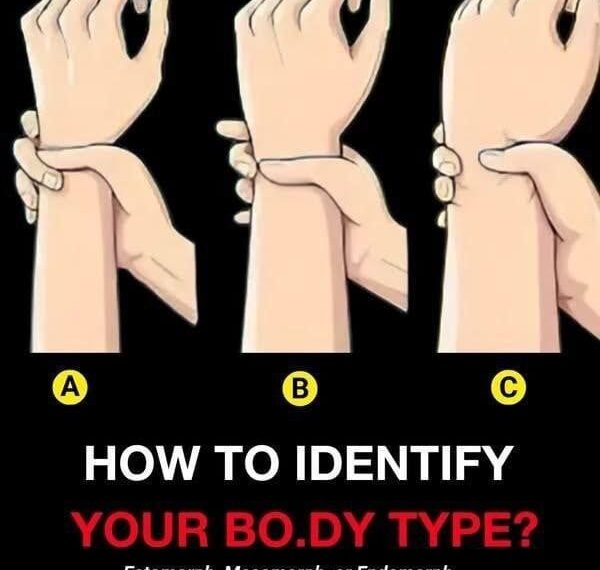
Have you ever wondered why some people seem to gain muscle easily, others stay naturally slim, and some gain weight more quickly? The image you shared refers to the classic somatotype theory, which categorizes bodies into three general types: ectomorph, mesomorph, and endomorph.
Let’s break it down in a detailed and practical way so you can understand what it really means — and how to use this information wisely.
🔎 The Wrist Test: A Quick Visual Clue
The image shows a simple wrist test:
- A – Fingers overlap easily → Likely Ectomorph
- B – Fingers just touch → Likely Mesomorph
- C – Fingers don’t touch → Likely Endomorph
This test gives a rough idea of your bone structure. Smaller wrists usually indicate a lighter frame, while wider wrists suggest a broader skeletal structure.
⚠️ Important: This test is only a general indicator — not a scientific diagnosis.
📚 Where Did Body Types Come From?
The concept of body types (somatotypes) was introduced in the 1940s by psychologist William Herbert Sheldon. He believed body structure was linked to personality traits — though modern science does not support the personality connection.
Today, fitness professionals use somatotypes mainly to understand metabolism, muscle-building tendencies, and fat storage patterns.
1️⃣ Ectomorph: The Naturally Slim Type
🔹 Physical Traits:
- Narrow shoulders and hips
- Small joints and thin wrists
- Lean muscles
- Fast metabolism
- Difficulty gaining weight or muscle
🔹 Strengths:
- Can eat more without gaining much fat
- Naturally lean appearance
🔹 Challenges:
- Struggles to build muscle mass
- May look “skinny” despite training
🔹 Best Fitness Strategy:
- Focus on strength training
- Lift heavier weights
- Reduce excessive cardio
- Eat calorie-dense, protein-rich meals
🔹 Nutrition Tip:
Increase healthy carbs (rice, potatoes, oats) and protein intake to support muscle growth.
2️⃣ Mesomorph: The Athletic Type
🔹 Physical Traits:
- Broad shoulders
- Narrow waist
- Medium bone structure
- Gains muscle easily
- Balanced metabolism
🔹 Strengths:
- Builds muscle quickly
- Responds well to training
- Naturally athletic look
🔹 Challenges:
- Can gain fat if diet isn’t controlled
- May rely too much on genetics
🔹 Best Fitness Strategy:
- Combine strength training and moderate cardio
- Maintain balanced nutrition
- Stay consistent
🔹 Nutrition Tip:
Balanced macronutrients (protein, carbs, healthy fats) work best.