

6
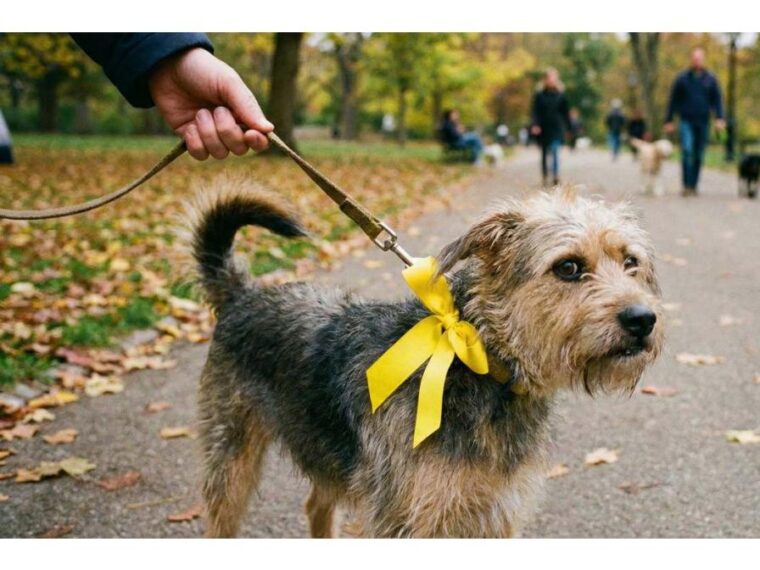
Have you ever noticed a dog wearing a yellow ribbon, yellow bandana, or yellow accessory on its collar or leash and wondered what it means?
It may look like a simple fashion choice, but in many cases, a yellow ribbon is intended to communicate an important message: “Please give this dog some space.”
The yellow ribbon is commonly associated with the Yellow Dog Project, an awareness initiative that encourages owners to use a yellow marker to indicate that their dog may need additional distance from unfamiliar people or other dogs.
However, the meaning is not always universal, and a yellow ribbon does not automatically mean a dog is dangerous or aggressive. There are many different reasons why a dog might need extra space.
Let’s take a closer look at what the yellow ribbon means, why owners use it, and what you should do when you see one.
🟡 What Does a Yellow Ribbon on a Dog Collar Mean?
A yellow ribbon or other yellow marker on a dog’s collar, harness, leash, or bandana generally means:
“This dog needs space. Please don’t approach without asking.”
The message is primarily intended for people and other dog owners.
The dog may be uncomfortable with close interactions, overwhelmed by unfamiliar environments, recovering from an illness or injury, undergoing training, or simply need more personal space.
The yellow marker gives the owner a simple visual way to communicate this without having to explain the situation to every person who approaches.
It can mean:
- Please don’t pet the dog.
- Please don’t approach the dog.
- Keep your dog away from this dog.
- Don’t allow children to run up to the dog.
- Give the dog additional distance.
- Ask the owner before interacting.
- Allow the dog and owner to pass without interruption.
The exact reason varies from dog to dog.
🐶 What Is the Yellow Dog Project?

The Yellow Dog Project is an awareness campaign designed to help dogs that need additional space.
The idea is relatively simple: a yellow ribbon, yellow leash, yellow bandana, or another yellow item can act as a visual signal that the dog should not be approached casually.
The initiative aims to improve communication between dog owners and the public.
Instead of an owner repeatedly saying:
“Please don’t touch my dog.”
the yellow marker can provide an immediate visual cue.
It’s especially useful in busy places such as:
- Parks
- Sidewalks
- Dog-friendly stores
- Outdoor cafés
- Training classes
- Veterinary clinics
- Public events
- Neighborhoods with many dogs
⚠️ Does a Yellow Ribbon Mean the Dog Is Aggressive?
No.
This is one of the most important things to understand.
A yellow ribbon should not automatically be interpreted as “dangerous dog.”
A dog wearing yellow could be nervous, anxious, elderly, injured, recovering from surgery, reactive, easily overwhelmed, or simply in training.
For example, imagine a dog that becomes uncomfortable when strangers get too close.
Its owner may use a yellow ribbon to communicate:
“Please give us some room while we’re working on this.”
That doesn’t necessarily mean the dog wants to attack anyone.
In fact, the yellow marker can be part of a responsible owner’s effort to prevent stressful situations before they happen.
💛 Why Might a Dog Need Extra Space?
There are many possible reasons.
1. The Dog Is Nervous Around Strangers
Some dogs are naturally cautious around unfamiliar people.
A stranger reaching toward the dog’s head can be frightening, particularly if the dog hasn’t been properly socialized or has had unpleasant experiences in the past.
Giving the dog more distance can help it remain calm.
2. The Dog Is Reactive
Some dogs react strongly when they see:
- Other dogs
- Strangers
- Children
- Bicycles
- Cars
- Skateboards
- Loud noises
A reactive dog isn’t necessarily an aggressive dog.
Reactivity can involve barking, lunging, pulling, whining, freezing, or becoming highly alert.
Creating distance can help prevent the dog from becoming overwhelmed.
3. The Dog Is Being Trained
A yellow marker can also be useful during behavior training.
An owner may be teaching a dog to:
- Ignore other dogs
- Walk calmly on a leash
- Focus on its handler
- Remain relaxed around strangers
- Stop jumping on people
- Become comfortable in public places
Unexpected interactions can interfere with training.
The yellow ribbon communicates that people should allow the owner to work with the dog without approaching.
4. The Dog Is Recovering From an Injury
A dog recovering from surgery, an injury, or another physical problem may need to avoid excitement and physical contact.
Even a friendly dog can accidentally hurt itself if someone encourages it to jump, play, or move suddenly.
A yellow marker can help communicate:
“Please don’t interact with my dog right now.”
5. The Dog Is Elderly
Senior dogs may have reduced:
- Hearing
- Vision
- Mobility
- Patience
- Tolerance for physical handling
An unfamiliar person suddenly touching an older dog can startle it.
Extra space can make walks safer and more comfortable.
6. The Dog Is Sick
Some dogs may need space because they’re unwell.
They may feel uncomfortable, tired, nauseated, or sensitive to touch.
Their owner may not want other dogs approaching them, particularly if interaction could cause stress or interfere with recovery.
7. The Dog Is Overstimulated
Busy environments can be overwhelming for certain dogs.
Imagine a dog walking through a crowded park surrounded by:
- Barking dogs
- Running children
- Loud conversations
- Bicycles
- Strange smells
- People reaching toward it
Even a normally friendly dog can become overwhelmed.
Distance gives the dog an opportunity to calm down.
🟨 Yellow Doesn’t Always Mean the Same Thing
It’s important to understand that there isn’t a single globally standardized meaning for every yellow ribbon worn by every dog.
One owner might use yellow because their dog is reactive.
Another might use it because the dog is nervous.
Someone else might use a yellow bandana simply because they like the color.
And some owners may not know about the Yellow Dog Project at all.
Therefore, you shouldn’t make assumptions based solely on the color.
If you’re unsure, the safest approach is to respect the space and ask the owner if interaction is appropriate.
🐕 What Should You Do If You See a Dog Wearing a Yellow Ribbon?
The best response is simple:
Give the dog space.
Don’t walk directly toward it.
Don’t reach out your hand.
Don’t try to pet it.
Don’t encourage your children to approach.
And if you have your own dog, keep your dog at a comfortable distance.
If you need to pass the dog on a narrow sidewalk, give the owner as much room as reasonably possible.
🚫 Don’t Assume “He’s Friendly!”
One of the most common mistakes people make is saying:
“Don’t worry, my dog is friendly!”
That’s not necessarily helpful.
The yellow-marked dog may not be comfortable interacting with another dog, regardless of how friendly the other dog is.
Think about it this way:
Your dog might love meeting other dogs.
The other dog might not.
Both dogs can be perfectly good dogs while having completely different social preferences.
👧 Teach Children About Yellow Ribbons
This is especially important.
Children are naturally curious about dogs and may want to pet every dog they see.
Teach children that they should never approach an unfamiliar dog without permission from the owner.
If the dog has a yellow ribbon, bandana, leash, or other yellow marker, treat it as an especially strong reason to keep your distance.
A good rule for children is:
“Stop, look, and ask.”
- Stop a few feet away.
- Look at the dog and its body language.
- Ask the owner before approaching.
And if the owner says no, simply move on.
🦮 What About Other Dogs?
Dog owners should pay particular attention to yellow markers.
If your dog sees another dog wearing yellow, don’t assume that the dogs should meet.
Instead:
- Shorten your dog’s leash if necessary.
- Keep your dog under control.
- Move to the side of the path.
- Give the other dog plenty of room.
- Avoid forcing an interaction.
- Follow the yellow dog’s owner’s cues.
This can make walks much more comfortable for everyone.
🧠 Learn to Read Dog Body Language Too
A yellow ribbon is only one form of communication.
Dogs communicate heavily through body language.
Signs that a dog may be uncomfortable include:
- Turning its head away
- Avoiding eye contact
- Lip licking
- Yawning when not tired
- Lowering its body
- Tucking its tail
- Pinning its ears back
- Freezing
- Hiding behind its owner
- Trying to move away
- Excessive panting
- Growling
- Barking
- Lunging
These signals shouldn’t be ignored.
A dog that is trying to move away is essentially communicating:
“I need more distance.”
Respecting that signal can prevent a situation from escalating.
🟡 Yellow Ribbon vs. Other Dog Warning Colors
You may also encounter different colored accessories on dogs.
However, unlike traffic lights or standardized safety signs, dog collar and leash colors don’t have one universal international code.
Some organizations, trainers, owners, or communities may use colors differently.
That’s why you shouldn’t automatically assume that:
- Red always means aggressive.
- Green always means friendly.
- Blue always means service dog.
- Yellow always means dangerous.
The meaning depends on the specific context.
A yellow ribbon associated with the Yellow Dog Project generally communicates “needs space,” rather than “dangerous.”
🩺 Yellow Ribbons Can Be Particularly Helpful at the Vet
Veterinary clinics can be stressful environments.
A waiting room may contain several unfamiliar animals and people in a relatively small space.
A dog that normally behaves well at home may become nervous in this environment.
A yellow marker can help communicate that the owner would prefer:
No greetings, no touching, and no close interactions.
Some clinics may also have separate waiting areas or other procedures for dogs that need additional space.
🌳 Why Distance Can Help a Nervous Dog
Distance isn’t simply about avoiding interaction.
For many dogs, distance can reduce stress.
Consider a dog that becomes nervous around other dogs.
At 30 meters away, it might calmly look at another dog.
At 10 meters, it might become tense.
At 3 meters, it could start barking or lunging.
The closer the trigger gets, the harder it may become for the dog to remain calm.
Giving the dog additional space can therefore help the owner manage the situation and continue training.
💡 The Yellow Ribbon Is a Communication Tool
Think of it like a visual “please give us space” sign.
It allows owners to communicate quickly in situations where explaining everything would be inconvenient.
Instead of stopping every passerby and saying:
“My dog becomes nervous when strangers approach, so please don’t pet him.”
the yellow marker can provide an immediate clue.
It isn’t a replacement for responsible handling, training, or supervision—but it can be a helpful communication tool.
❗ What a Yellow Ribbon Does NOT Mean
A yellow ribbon does not necessarily mean:
❌ The dog is dangerous.
❌ The dog has bitten someone.
❌ The dog hates people.
❌ The dog hates other dogs.
❌ The dog is poorly trained.
❌ The dog should be feared.
❌ You need to panic when you see it.
Instead, the safest interpretation is:
“This dog may need extra space. Respect the owner’s request.”
🐾 If You’re the Owner of a Dog That Needs Space
If your own dog becomes nervous, reactive, or uncomfortable around people or other dogs, a yellow marker may be one useful communication method.
You might choose:
- A yellow ribbon
- Yellow leash
- Yellow harness
- Yellow bandana
- Yellow collar accessory
But don’t rely on the color alone.
Good management can also include:
Choosing quieter walking routes
Busy dog parks aren’t suitable for every dog.
Walking during quieter hours
Early morning or later evening walks may provide fewer encounters.
Creating distance
Crossing the street or stepping aside can prevent unnecessary interactions.
Training
Reward-based behavior training can help dogs learn calmer responses to triggers.
Communicating clearly
If someone approaches despite the yellow marker, politely say:
“Please give us some space.”
Your dog’s comfort and safety are more important than avoiding an awkward conversation.
🧒 What Parents Should Teach Kids
A simple lesson can make a huge difference:
Never run toward an unfamiliar dog.
Never hug a strange dog.
Never put your face close to a dog’s face.
Never grab a dog’s collar.
Never take food or toys from a dog.
Always ask the owner before petting.
Give yellow-marked dogs extra space.
These rules are useful even when the dog appears friendly.
❤️ Respecting the Yellow Ribbon Helps Dogs and Owners
When people respect a yellow ribbon, everyone benefits.
The dog gets the space it needs.
The owner feels less pressure during walks.
Other dogs are less likely to become involved in stressful interactions.
And potentially dangerous situations can be prevented before they begin.
Most importantly, respecting the signal helps create a culture where people understand that not every dog wants to say hello.
🌟 Final Thoughts
The next time you see a yellow ribbon, yellow bandana, yellow leash, or another yellow marker on a dog’s collar or harness, don’t assume that the dog is aggressive or dangerous.
In the context of the Yellow Dog Project, yellow is generally a request for space and caution around interactions.
The dog may be nervous, reactive, elderly, recovering from an injury, undergoing training, overwhelmed by its environment, or simply uncomfortable with unfamiliar people or dogs.
The best response is easy:
Slow down. Give the dog space. Ask the owner before approaching.
That small act of consideration can make a big difference to both the dog and its owner. 🐕💛